
You can help to tenfold the number of trees
Revitalize degraded farmland with native trees in Bolivia
Price per tree: DKK 16 (2.15€)
Revitalize farmland in the Amazon with native trees
Reforestation projects in Bolivia give our donors the opportunity to make a big local difference through the establishment of forests on depleted agricultural- and cattle farming land. By planting 100-150 baru trees per hectare, the number of trees increases tenfold. In addition, donated trees create local jobs, improve everyday life for the local community, and help restore biodiversity.
- The companies donate trees to an entire area or part of the areas.
- Private individuals donate a number of trees via our webshop, which are planted together with other customers' donated trees.
Price per tree: DKK 16 (2.15€)
The Baru Tree
The baru tree is an endangered tree specie in the Cerrado biome of South America, especially in Brazil and Bolivia. It grows in tropical to subtropical areas, mainly in areas with 500-2,000 mm of rain annually, partly on the savannah (grassland, bushes and trees) and partly as parts of actual forests. It will typically be 60 - 70 years old, 10-12 m high with a diameter of up to 70 cm and usually stands in small groups. It is a semi-hardwood similar to beech and can be used for tools, furniture and house construction.
How your donated trees are planted
In Bolivia, we collaborate with FOOD BY NATURE, a Danish-Bolivian company which through cooperation with local companies and organizations create long-term reforestation solutions that are both economically and climatically sustainable.
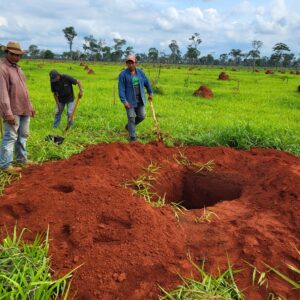
In general, planting trees in Bolivia is a 98% manual task. Planting 2,000-2,500 trees typically takes 98 working days and two tractor days. For each baru tree planted the soil is prepared by digging a hole of 1.5m x 1m x 1m. The tractor is used for the heaviest work. With 100 paid work days, a reforestation project is welcome for local people in rural areas where paid work is limited. The first planting project in the Santa Cruz region is near the village Comunidad San Juan Bautista - see the area in Google Maps here
The plant process
- The state of the soil is examined by digging a hole of 1.5 m x 1 m x 1 m.
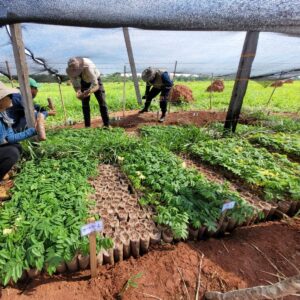
- A small nursery will be built next to where the planting will be done. Here, the tree's core - the baru nut - is planted in each their plant bag.
- When the soil, temperature and humidity are optimal, the small baru tree sprouts after a few days. In 17 days, it will germinate, and 2 weeks after it is ready to be planted.
- It is marked with a wooden stick to avoid it being stepped on by people and to make it accessible to check whether all trees are in good condition.
Revitalization of degraded agricultural land
In the tree's natural growth area, there are large areas of degraded agricultural land that has lost its fertility. The Baru tree has a number of properties that are effective in revitalizing degraded or eroded agricultural land:
- It adds nitrogen to the soil, as the Baru tree is a leguminous plant.
- Its large root network and the micro-life around it give the soil porosity so that it can absorb water and nutrients.
- From the tree is 2 years old, it can co-exist with cattle. As it also provides shade for the cattle, it is welcome on run-down cattle farms.
Since the tree originated in the region and in this climate, it does not need watering. Its survival rate is high – after the age of 2, approx. 99% of the trees survives. Often there are 2-10 trees per hectares on the run-down cattle farms, but we bring this up to 100-150 trees per hectare - i.e. a tenfold increase.
See example of the Forest Certificate here
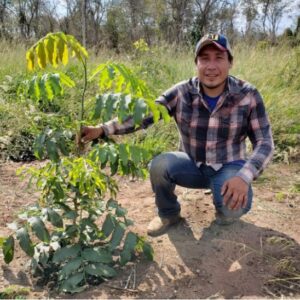
Picture no. 3: Baru tree 1 year old
Picture no. 4: Baru tree 20 years old

The fruits of the baru tree
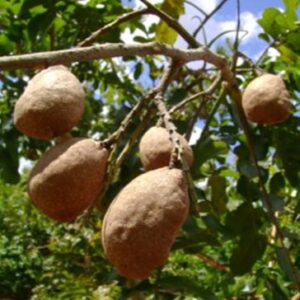
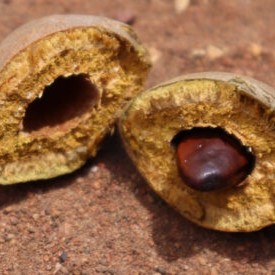
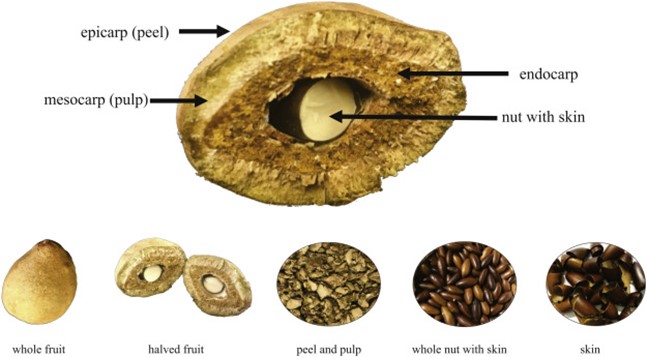
An adult, free-standing baru tree produces approx. 150 kg of fruit per year. When the trees are in the forest, however, it will be quite a bit less. They need direct sun light to reach good production levels. The fruits have a layer of sweet pulp on the outside. It is used by the local population or eaten by cattle, other mammals and birds. Beneath the layer of pulp is a woody "shell" (husk). Underneath the woody layer are the seeds of the tree. It resembles a nut. Locally it is called an almond (Almendra de Chiquitania), but the most common name outside South America is a Baru nut.
The nut is nutritious, with its protein and oil content. The fruits and other parts of the tree seem to have a number of uses in medicine and nutritional regulation, but this has not yet been fully explored.
Important for the local communities
The whole fruit of the baru tree is used by the local communities. First of all, the nut is an important dietary supplement and with its high protein
content reduces the need for meat. In connection with the planting project, our local forest partner 4EverForest has developed a special "nutcracker" so that the nut can come out of its casing hole. This improves sales and export opportunities. There is an export in progress, mainly to the USA and Canada. This provides the local communities with a needed income opportunity.
In the area where the baru tree grows, the woody and thick "shell" around the nut is used by the local population for charcoal. This reduces the need to cut down trees and bushes for cooking etc. Our international CSR partner in Bolivia, Swiss Contact, has, in connection with the preparations for the planting of the baru trees, ensured the development of a tool for the local communities to press the charcoal into briquettes, so that it can be transported and sold, e.g. as barbecue charcoal.
Click on picture no. 4 below and see the content of the Baru fruit.

The area
Our first baru tree forest is located in the Santa Cruz region of Bolivia. It is an area where there was originally tropical forest, which in some places has the character of a rainforest, and in others a savanna-like landscape with trees, bushes and grass. In many places the forest still stands, but in an increasing number of places the forest has either been cleared or burned to make way for agriculture.
This started in the 1950s, when food had to be provided for a still starving world. Emigrants sought away from poor economies in most of the world to areas where there was available land. With the ever-increasing pressure on food production, this tendency has continued.
After 10-50 years of use as agricultural land, the soil is worn out and barren, and its degradation - erosion - becomes evident. When tropical soil is cleared, it is exposed to strong sun and heavy tropical rain, which quickly breaks down the fertile layer and washes it away. After that, it is difficult to get anything other than grass to grow and biodiversity is then reduced by more than 95%. There are thousands upon thousands of such degraded and eroded farmland in the Santa Cruz region of Bolivia.
The global perspective
Some sources mention the baru tree as an endangered tree. However, we will not take this as income for the project, as we know that it still exists in the thousands in Bolivia alone. The sources' assessment is presumably due to the fact that the tree's largest growing area, the Cerrado biome in Brazil, is undergoing rapid degradation as a result of involvement in agriculture and extensive forest fires.
The planting of baru trees provides both globally and locally several significant advantages. In our baru plantings, we tenfold, area by area, the number of trees, which over the next 10-50 years will have a great effect.
Erosion and climate
Every year, 600,000 km2 of soil is destroyed by erosion. When we increase the number of baru trees tenfold, the soil gets renewed growth and ability to absorb water, as well as protection from sun and tropical rain. It reduces erosion, and we get the land from being on the verge of being barren and unproductive, to being able to form the basis for both trees and food production.
When we increase the number of trees tenfold, the absorption of CO2 increases. This reduces the climate impact, which in turn reduces erosion.
Food production and baru trees can co-exist
From 2010-2050, the global need for food will double. This means that either trees and food production must be able to co-exist, or forest and nature areas corresponding to approx. the current agricultural area is included for agriculture.
It is therefore important to us that with the baru tree we can both tenfold the number of trees, and at the same time help increase food production. This is crucial for the future of the planet.
"Gold is a luxury. Trees are necessities.
Man can live and thrive without gold, but we cannot survive without trees."
- Paul Bamikole
