Help restoration of the Amazon rainforest in Bolivia
Rewilding in collaboration with the Takana people in and around Madidi National Park
Price per tree: DKK 16 (2.15€)
Rewilding of the rainforest
In this project we are doing "Rewilding". That is, we recreate a piece of nature as close to its original appearance and composition as possible by rebuilding the forest with the shrubs and trees that were originally present.
The approach is that you plant the most important and most distinctive trees (base trees), while the other species of trees and shrubs - in the Amazon forest typically 70-150 species - are spread as seeds from the surrounding forests and let nature decide which ones survive.
We are doing this because the Amazon forest - the last great rainforest on Earth - has been heavily felled for the past 60 years. Therefore, it is important to rebuild the parts that can still be saved, and to do so in a way that allows the indigenous people of the forest to continue living.
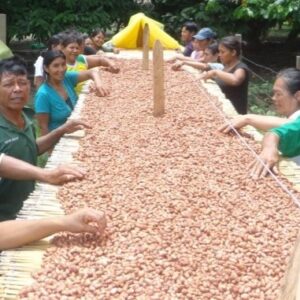
Wild cocoa trees are planted among the base trees. The Takana people are one of the cultural and linguistic groups that live by collecting wild cocoa during the summer months (rainy season). They live in and around Madidi National Park.
Re-establishing biodiversity
Rewilding can help restore forest biodiversity. After deforestation, most animals have been killed or have lost their habitat, and they cannot live in "traditional" forests with few different trees. But they have a better chance of doing so in the "rewilded" forest, where it is expected that mammals, birds and insects will be back after 5-10 years.
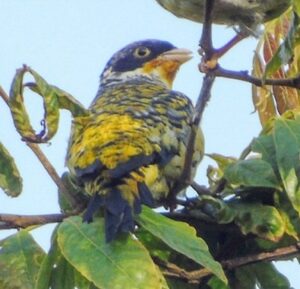
The bird Alcachupa is endangered because its last habitat is less than 1 km2. Photographed below near the village of Apolo.
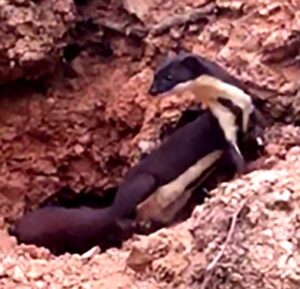
The Amazon weasel is among the world's most unknown animals. The photo below is from the first video of the animal, taken in the Teoponte area north of La Paz in Bolivia.
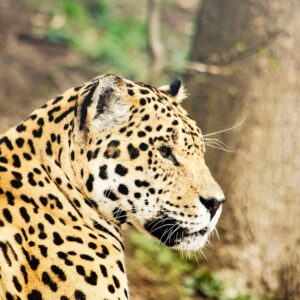
The jaguar has the world's highest density, 3 per 100 km2, in the Madidi National Park, which is one of the areas that wants Rewilding with cocoa trees.
See example of the forest certificate here
Rainforest that will not be cut down again
Among the basic trees planted in this project are wild cocoa trees, which are native trees in the Amazon forest. They give the forest a value as a living forest, as the wild cocoa beans are highly sought after for the production of chocolate.
During the rainy season, which lasts 4-5 months, the wild cocoa beans are the only opportunity for the forest people to earn a cash income. For many families, it is what allows them to have money for school books, doctors and medicine.
The wild cocoa allows the forest people to stay in the forest. And as long as they do this, the forest is protected and will not be cleared for plantations and cattle.
About the collaboration
Our local partner Swisscontact is an independent Swiss-based NGO with branches in more than 30 countries. They work particularly with the development of agricultural forms, including nature-conserving agricultural forms, technology for the agricultural sector, and training of farmers. They are responsible for the contact with the communities, monitoring the cocoa trees and calculating their CO2 absorption, as well as photo and video documentation. Swisscontact also collaborates with several local NGOs, government organizations and universities, from which knowledge can be drawn upon when necessary.
The indigenous communities, who have the right of use to the land on which the forests will be located, carry out the planting and sowing. Food by Nature ApS strives to ensure that high-quality chocolate is produced from the cocoa beans, and that the chocolate also reaches the market in Denmark.
"When you are lost in the wilderness,
a tree will always point you in the right direction."
— Anthony T. Hincks