

Pushing private capital out of Denmark
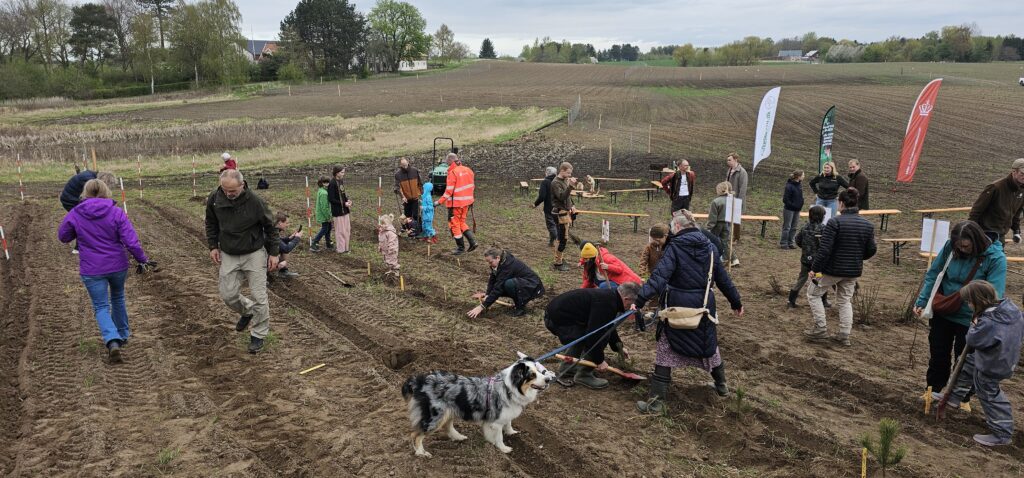
The upcoming subsidies provided by the Ministry of Green Transition are so high that it might force companies to direct donations towards afforestation projects in other countries. This means that valuable capital is wasted, according to Growing Trees Network, which raises forests with private donations and proposes to equate private and public subsidy schemes to create a level playing field.
Not only in Denmark – but throughout the EU – private capital is a necessity to achieve the ambitious goals of afforestation by 2050. Without them, it will happen too slowly.
The Ministry of Green Transition has set a goal of raising 250,000 hectares of forest on agricultural land and allocated DKK 40 billion for the conversion. But that is not enough.
Private market is growing
In recent years, a market for privately financed afforestation has emerged. For example, it may be companies where it is not physically possible to reduce CO2 emissions further in the given year. Here, afforestation can be a contribution to climate action – often corresponding to the emissions that the company cannot reduce itself.
With the Danish Climate Forest Fund, the focus has turned to companies’ ability to reduce Denmark’s climate footprint by supporting afforestation projects via contribution credits. The contribution credits can be included in companies’ ESG accounts and documented as efforts “Beyond Value Chain” – i.e. outside the company’s value chain.
If companies are to deduct the CO2 storage from afforestation in their direct emissions (scope 1), it requires ownership of the land on which the forest stands. But especially for the smaller companies, it is not a realistic option.
So, if a company doesn’t want or need contribution credits or to invest in the purchase of land to plant forest itself, what are their options?
ESG documentation drives demand
For many companies, reducing CO2 emissions is not the primary reason behind their desire to contribute to afforestation projects. 90-95 percent of our corporate sponsors highlight the many other beneficial effects of afforestation as the primary reasons for their commitment: better climate, increased biodiversity, more nature, more recreational areas, protection of aquifers and reduced carbon emissions.
In companies’ ESG reporting, afforestation can provide valuable points in the environmental points of climate change, water resources and biodiversity. At the same time, it documents the company’s social responsibility.
With the upcoming EU requirements for companies’ ESG documentation, this source of funding for afforestation is expected to increase significantly in the coming years. This will play a significant role in achieving Denmark’s afforestation goals faster. However, as Denmark’s largest non-governmental subsidy provider, we expect a level playing field.
But what are the challenges? We can spot at least three important ones:
- Income compensation
The Ministry of Green Transition’s subsidy for landowners who want to plant forests is at least DKK 75,500. The subsidy consists of a reforestation subsidy of DKK 45,500 and compensation for reduced land value of DKK 30,000, called income compensation. This makes the total area grant from Green Tripart 30-50 percent higher than already existing grant schemes.
Private subsidy schemes like ours, which are based solely on donations, may find it difficult to compete if we also must match the income compensation. 80 percent of the donations we receive go directly to the landowner as a subsidy for the establishment of the forest. If we are not competitive on this subsidy, the landowner chooses another subsidy.
The consequence may be that companies that want to do afforestation for ESG purposes will look for other activities than afforestation, as it will simply be too expensive if they also have to help finance the landowner’s income compensation through their donation.
An amendment to the Danish Climate Forest Fund’s statutes, which gives them access to provide income compensation, is currently being processed. If only they are allowed to provide income compensation with funds from the Ministry of Green Transition, an inappropriate and monopoly-like situation will arise that does not promote afforestation in Denmark.
The solution is that all landowners should be able to receive income compensation – regardless of whether they choose a public, semi-public or private subsidy scheme for their afforestation. This will create a level playing field for grants for afforestation and ensure that all companies can contribute to afforestation in Denmark.
- Ensuring clean drinking water
New studies show that more than half of Danish drinking water wells are contaminated with pesticides. Therefore, like Danva and the Association of Waterworks in Denmark, we propose that the Ministry of Green Transition adds targeted protection of groundwater to the agreement, so that afforestation projects over important aquifers are given as high a priority as areas with nitrate leaching into the Danish fjords. This will open for more afforestation projects across the country.
- Additionality requirements
The primary precondition for issuing a contribution credit based on afforestation is the principle of additionality. This means that companies must document that given climate measures would not have been implemented after all.
But it is precisely the requirement for additionality that is challenged when the Ministry of Green Transition promises to deliver 250,000 hectares of publicly funded forest. How can companies argue that the forest would not have been raised anyway? Is it beyond 250,000 hectares? Companies that want to contribute to carbon reduction through afforestation projects may therefore be forced to apply for projects outside Denmark’s borders, as the prerequisites for issuing contribution credits may not be present in the Danish market.
100 percent clarity on this issue is needed as soon as possible, so that we avoid ambitious danish companies choosing not to invest in afforestation due to uncertainty and lack of transparency.
Alternatively, companies can choose a pure ESG approach, where the focus is on the other positive effects of afforestation. But there are probably very few private contributors who want to finance the landowner’s income compensation if other subsidy providers like the Minisrty of Green Transition and the Danish Climate Fund have access to this tax-financed pool.
Post written by Kim Nielsen, CEO of Growing Trees Network published in the Dansih Magazine: Skoven, see: Presser private penge ud af landet – Danish Forest Association