You can help tree projects for students in Uganda
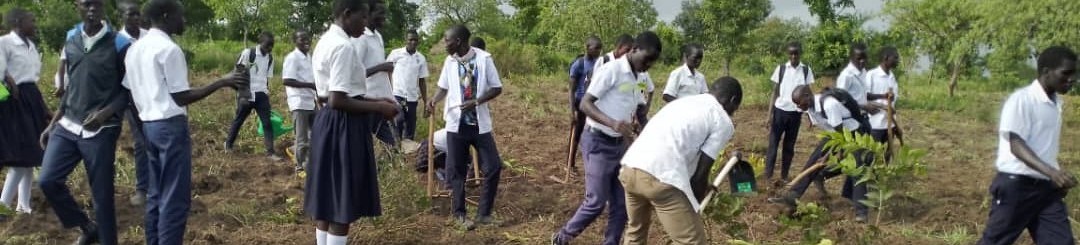
Indigenous tree species are planted in botanical gardens for the learning of the students and local population
Price per tree: DKK 16 (2.15€)
About the collaboration
In collaboration with the Danish organization Seniors Without Borders and their partner in Uganda, Youth Leading Environmental Change (YLEC), we carry out a project planting botanical gardens in the Soroti District in North-Eastern Uganda - see the area in Google Maps here
The botanical gardens are planted with indigenous trees or, colloquially, 'grandmother trees', as only the elderly can remember them. They have been felled and over the years tree species that are not as adapted to nature and hardy have been planted. This happens at 25 schools in the district, where we also carry out environmental projects that focus on more sustainable energy, tree planting and waste recycling. The students are organized in what are called Environmental Clubs and meet in the afternoon.
Learning for the population in the local area
In addition to planting a selection of indigenous tree species, the botanical gardens will also be training centers where the public can learn about the trees and their properties. It is also planned that they will later be able to buy plants for their own farms. And learn about the importance of tree planting in connection with adaptation to the changing climate conditions.
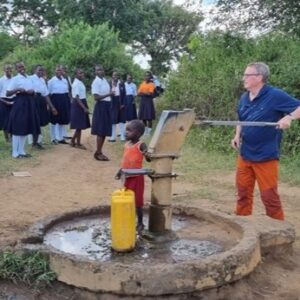
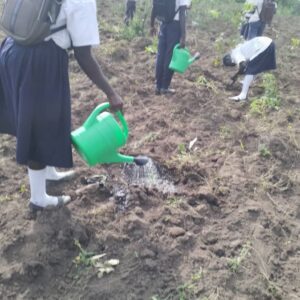
The photos below are from Katine Secondary School, which has a total of 1,000 students of both sexes. The school has 5 hectares of land and has made half available for the project. The students are responsible for planting and caring for the trees. In the long term, we hope to continue the project to other schools in the district.
See exampel of the certificate here
See a list of tree species planted in the area at the bottom of the page.
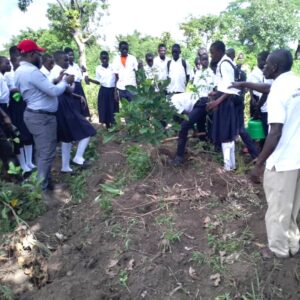
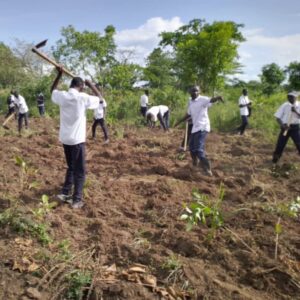
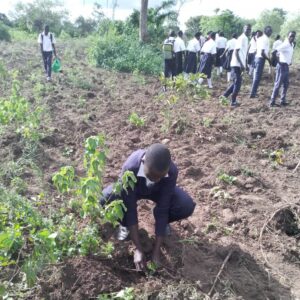
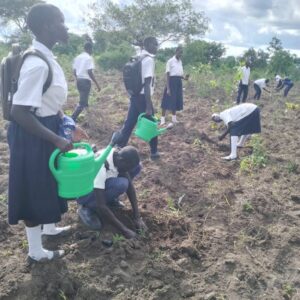
From Seniors without Borders' visit to Uganda, spring 2023
The rainy season is over, the sun is high in the sky, we are heading into the long dry season. We are visiting Katine Secondary School located almost 20 km outside the main town of Soroti. Many years ago the area was pure bush. As the original vegetation is now gone, it is today a typical African agricultural area. Survival is a daily struggle, i.a. as the residents pay the price for the extensive tree felling.
The school is the first to benefit from the support of the Growing Trees Network. They have started to create a botanical garden, where 'grandmother trees' or, in the technical language, original tree species, are planted. Trees adapted to the environment are hardier than the new hybrid types.
Sharifa, a 15-year-old girl, is proud of what she has done. She has planted many trees and has shown them to her parents who live nearby. She is looking forward to them growing bigger and to one day being able to show them to her own children. She is also happy that there is water nearby, so that she and her friends don't have to walk so far with the water jugs. It was fun clearing the area together and planting the 1000 trees they reached. It became even funnier when the representative from Seniors Without
Borders was asked to provide water for irrigation. She says that they want to plant many more trees in September, when the next rainy season should start. 40 of the school's students are members of an environmental group that has been trained in tree planting, building stoves that use less firewood and waste sorting. They have learned to make fertilizer from the organic material for the benefit of the trees. They do the same at home.
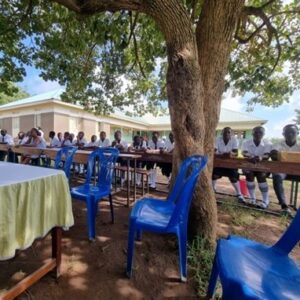
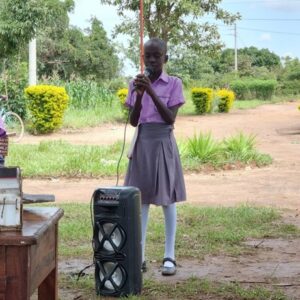
Dakabela Comprehensive Secondary School is another school to benefit from the program funded through the Growing Trees Network. When we arrive, students from another nearby elementary school also participate. We get a warm welcome with singing and dancing by the students, as well as a touching poem performed by a girl about the importance of fighting for the environment.
Here, too, an environmental group of 40 has been created among the 360 pupils. Planting has not started yet - it will start in September 2023.
In fact, there are far more schools that would like to be part of the program. Especially the schools that are outside the cities, where there is enough space.
By: Poul Krøijer, Seniors without Borders
List of indigenous trees planted at Katine Botanical Garden
* Tree Species Associated purpose
| 1 | Indian teak | medicinal helps majorly in reducing human fats, this is from the leaves and its oil from the seeds is used for treating skin diseases. It is one of the faster growing hardwoods. It takes 20 t0 25 years to final harvest. |
| 2 | Musizi | good for fuel wood and timber takes roughly 15 to 20 years but by 10 years it has a big stem enough for harvesting. |
| 3 | Markhamia | tree leaves and barks are medicinal used mainly as pain killers of for example toothache, stomachache, headache, cough, asthma, gonorrhea and convulsions in children. This tree takes a longer time of about 60 years to be harvested |
| 4 | Calliandria | tree is mainly for soil fertility and foliage used as fodder for livestock. It takes a very short time to reach majority. Roughly 6 to 8 months. |
| 5 | Jacaranda | medicinal, leaf baths used in treating wounds and skin infections. This will most often grow to less than 8m tall, although it can reach 12-15m under ideal conditions taking 20 plus years to do so. |
| 6 | Albizzia | this beautiful but relatively short lived, deciduous tree can grow to a height of roughly 6m with a spread of 38m and has a fast growth rate of 25 to 50 cm per year. It is medicinal, used in treatment of cough, diarrhea, tuberculosis and wounds. |
| 7 | Cassia | the immaculate and abundant bunches of fragrant yellow flowers that this tree produces each year indeed remains in the memory of anyone who witnesses it, it reaches 30 t0 40 feet in less than 5 years. majorly medicinal, used to control blood sugar in diabetics, used for timber, it’s ornamental due to blossoms, used for fuel wood. |
| 8 | Mahogany | tree takes roughly 25 years to reach its full maturity, this tree thrives mostly in a salty air and moist soils. They require regular watering for optimal growth conditions. It increases ground water levels, counteracts soil erosion and largely contributes to a large degree to the entire ecosystem. |
| 9 | Black plum | tree takes 3 to 6 years after planting before mature enough to bear fruit, it is medicinal, used to prevent high blood pressure, heart diseases and stroke and provides fruits. |
| 10 | Mvule | this provides a wonderful shade, grow relatively quickly and have an excellent timber value when harvested after 20 to 30 years. |
* Tree Species Associated purpose
| 11 | Tamarind | tree started from cuttings will start producing fruits in 3 to 4 years while that started from seeds takes 6 to 8 years to fruit. When mature, the indehiscent brown pods shall appear a little ashy it is medicinal, promotes weight loss, prevents heart diseases, used for preparing local or traditional foods such as kalo, sweet potato bread and porridge, it is also used for making local soft drinks such as tamarina juice. |
| 12 | Neem | tree normally begins to bear fruit between 3 and 5 years and becomes fully productive in 10 years. It is mainly medicinal, treats fungal infections, insect and mosquito repellent, fuel wood and locally used to treat fowl diseases. |
| 13 | Grevillea Robusta | tree takes between 12 to 14 years to grow, it is for wood and construction materials. |
| 14 | Rosewood tree | the indigenous type takes 25 long years to reach harvesting stage, mainly medicinal, used to treat skin diseases, for construction and fuel wood. |
| 15 | Indigenous mango tree | after sprouting, the first mango harvest is expected in the next 3 to 6 years. Mango trees grown from seedlings like the ones in this botanical garden take 15 years before they produce a full crop, this is for majorly fruits and fuel wood. |
| 16 | Jack fruit | tree is a comparatively fast grower. In about 3 to 4 years after planting, you expect your jackfruit tree to produce harvestable fruits. This is one of the major fruits highly demanded in this area and they are getting scarce. |
| 17 | Desert date tree | takes roughly up to 4 years to mature- seeds crushed as fodder to livestock, source of craft materials used for making baskets, mats and parking materials, ornamental used for decoration, shelter materials and religious purposes. |
| 18 | Terminalia | tree takes roughly 08 to 10 years to mature, habitat for wildlife, conserves soil. |
| 19 | Moringa oleifera | is an extremely fast-growing tree species that takes 4 to 5 months to mature, well adapted to droughts and can reach a height of 400 cm in a year. This is mainly medicinal, used for treating a variety of diseases, used as fodder for livestock and conserves soil. |
"He that plants trees, loves others besides himself."
— Thomas Fuller